
Art essays
Guernica updated to the present day
“People assign meanings to certain things in my paintings; it may be true… but it is not my intention to give them one.”
— Pablo Picasso
I have never loved Pablo Picasso. In front of his works I always remain cold, emotionally detached, distant, full of doubts. Yet, as happens with all great artists, there are significant exceptions even for those who do not find themselves in his paintings, and for me one of these exceptions is undoubtedly Guernica.
In January 1937, Pablo Picasso was in Paris with a blank canvas before him and a commission he could not bring himself to face. The Spanish Republican government, losing the civil war against General Francisco Franco and his Nazi and Fascist allies, had commissioned him to create a large painting to be displayed in the national pavilion at the Paris World’s Fair.
Picasso was already the most famous painter in the world, as well as honorary director of Madrid’s Prado Museum. During those same months he had also produced a series of satirical etchings against Franco titled Dream and Lie of Franco. But the monumental work was slow to arrive. Inspiration remained silent.
Until one fateful day: April 26, 1937.
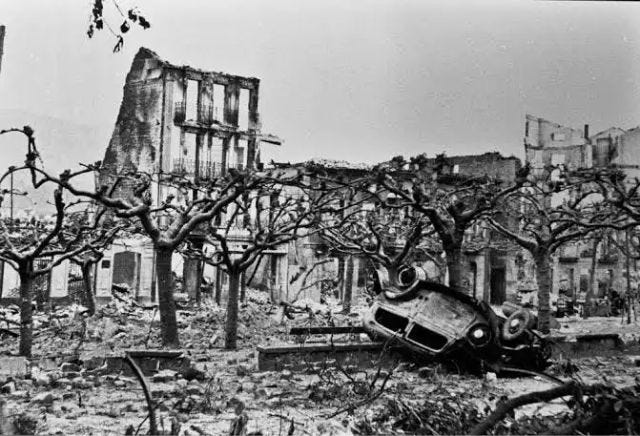
Guernica after the bombing of April 26, 1937
That Monday was market day in the small Basque town of Guernica. The streets were crowded with farmers, livestock breeders, women with children. At four-thirty in the afternoon the bombing began. The Nazi Condor Legion — part of the German Luftwaffe under the command of Hermann Göring — with support from the Italian Fascist Aviazione Legionaria, dropped 31 tons of bombs on a city without anti-aircraft defenses, without adequate shelters, without any form of protection. The raids continued for three hours, and for the first time terrifying phosphorus incendiary bombs were used. Guernica was razed to the ground and engulfed in flames. The Basque government counted 1,654 dead and hundreds wounded, among them elderly people, women, and children.
Technically, it was an experiment: as Hermann Göring would later declare, Guernica became a “testing ground” for evaluating the effectiveness of carpet bombing against a defenseless civilian population. It marked the beginning of a method that tragically continues to this day.
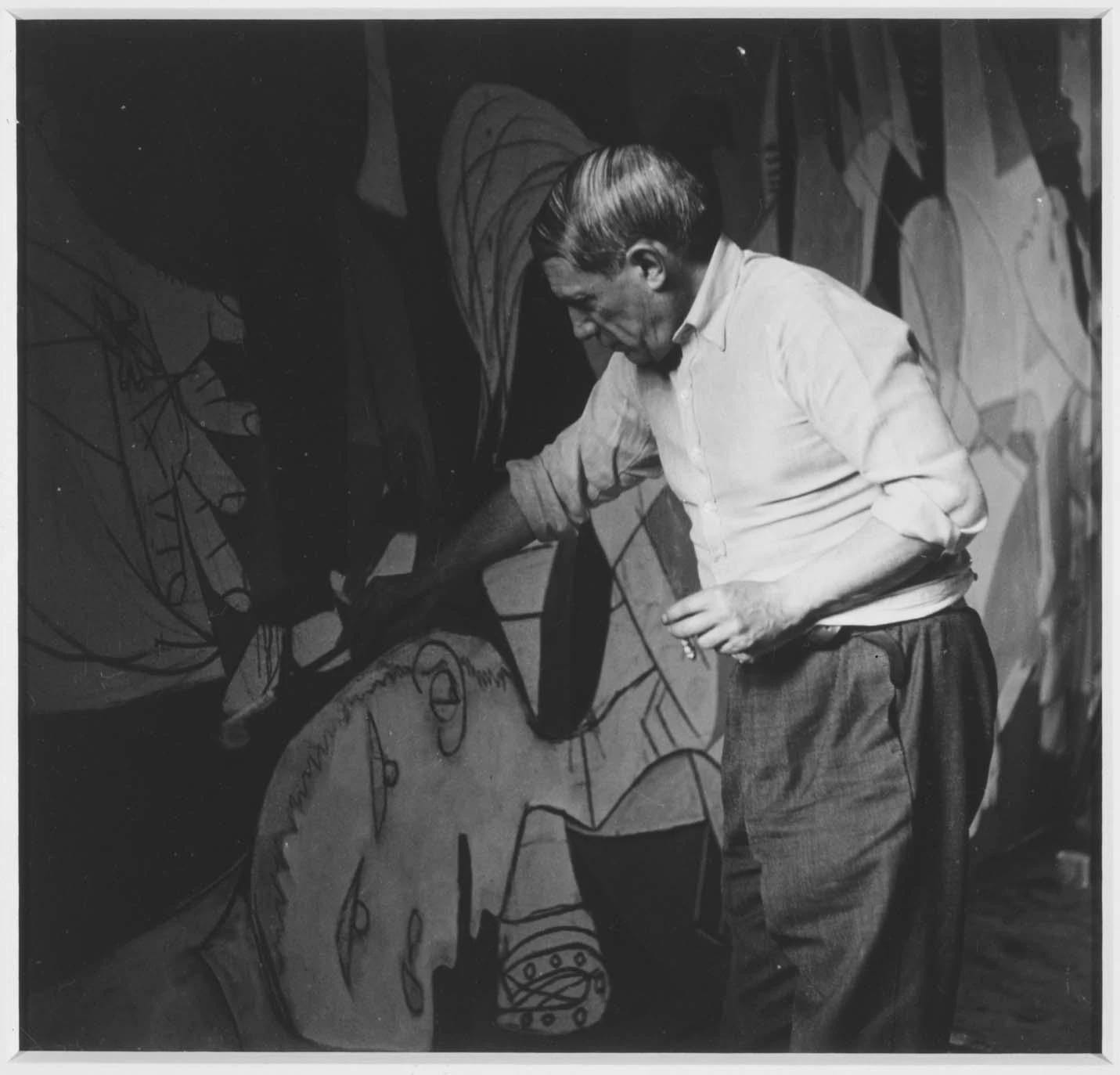
Pablo Picasso working on Guernica, photograph by Dora Maar.
Picasso learned of the massacre through newspapers. He was not a witness to the slaughter — he had lived in Paris for decades — but the reports from international correspondents, the photographs, the descriptions of the afternoon sky blackened by smoke and death stretching for miles struck him with a force that erased all hesitation. He immediately decided to change the subject of the painting. The canvas that was supposed to “represent Spain” would now represent that Spain: disemboweled, screaming, on its knees.
Picasso’s studio was on the first floor of 7 Rue des Grands-Augustins, just steps from the Seine. There stood a raw jute canvas of extraordinary dimensions: 349 centimeters high and nearly 776 wide — almost 27 square meters to fill.
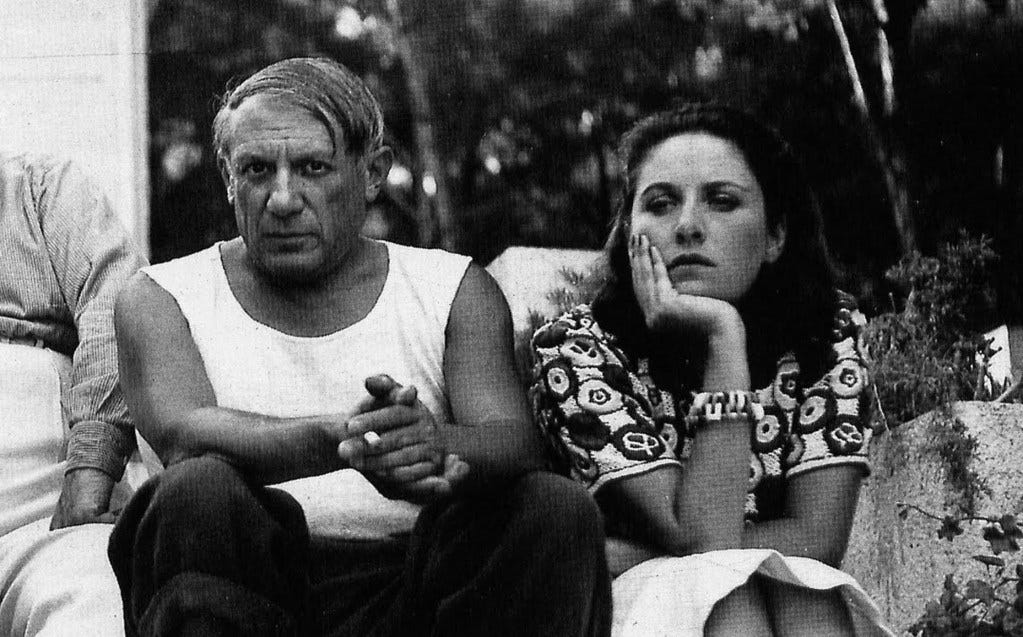
The woman sharing those months with Picasso was Dora Maar: photographer, artist, intellectual. Perhaps out of intuition, perhaps out of historical necessity, Dora Maar decided to systematically document every stage of the work. History and private life, love and death intertwined, and from May 11 to June 4, 1937, she took a series of photographs that reveal the genesis of the work day by day, like a slow-motion film of a creative explosion. Those photographs, published the same year in Cahiers d’Art, are now among the most precious documents in the history of modern art. Thanks to them we know how the painting changed from session to session, how certain figures appeared and disappeared, how chaos slowly organized itself into a definitive form.
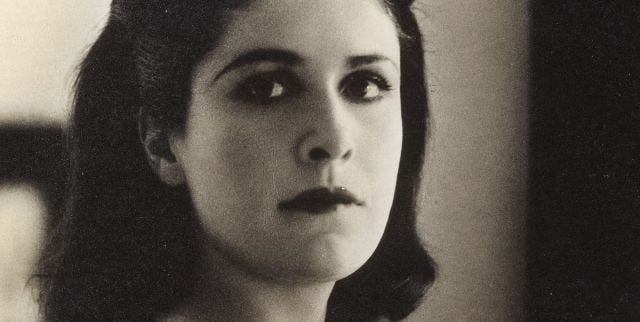
Dora Maar
Picasso completed the painting by the end of June, just in time for the Exhibition. He painted day and night, finishing it in less than two months.
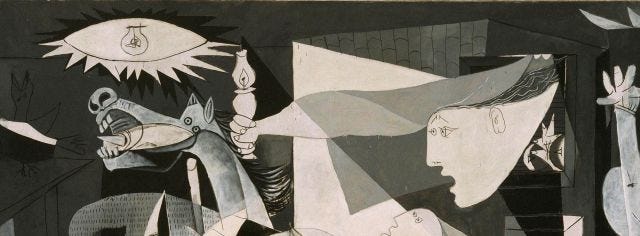
Guernica is read from right to left — that is how it was positioned in the Spanish Pavilion, with the entrance on the right. But before even choosing a starting point, one must first be struck by the whole: a gray, white, and black mass that seems to explode and compress at the same time, bodies and fragments of bodies crammed into a space with no depth because depth itself has been destroyed, trapped in a dynamic vortex. There is no sky. No horizon. Only this.
The work is brutally expressive, reproducing with surgical precision the chaos of a bombing.
The style Picasso adopted was the one he had developed in previous decades and then partially abandoned: Cubism, in its mature form. But here Cubism is no longer intellectual research or aesthetic provocation: it becomes an expressive instrument in the service of pain, screams, and horror. The possibility of showing a face simultaneously in profile and front view, of breaking a body apart and reassembling its fragments into impossible positions, of overlapping interior and exterior — all of this no longer serves to deconstruct reality, but to show its fragmentation, mutilation, and evil.
The setting is simultaneously interior — there is a ceiling, a lamp, the walls of a house — and exterior, betrayed by the fire of a burning building in the background. This simultaneity is not merely a Cubist device: it is the exact description of a bombing that tears through walls, violates domestic intimacy, and transforms the home into a slaughterhouse and open-air ruin.
Yet the composition is not chaotic. Picasso structures the canvas with almost classical rigor: three vertical axes divide it into panels, like a medieval triptych. The central group — the horse, the fallen warrior, the fleeing woman — is inscribed within a pyramid, the same geometric form Leonardo and Raphael used to anchor their sacred compositions. Inside the chaos, a cathedral.
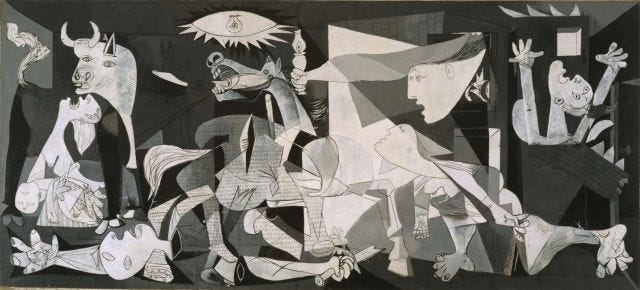
Pablo Picasso, Guernica, tempera on canvas, 349.3 × 776.6 cm, Museo Nacional Centro de Arte Reina Sofía, Madrid.
No symbol in Guernica has a single interpretation. Picasso never provided one, and he did so deliberately. He always refused to be reduced to a political artist, repeating that painting “was not invented to decorate apartments — it is an instrument of war for attack and defense against the enemy.” But weapons, as we know, can be wielded in many ways.
The mother with the dead child is the first figure encountered moving down through the composition. She clutches the body of a child — pupil-less, already abandoned by life — and releases toward the sky a heart-rending scream whose very shape can be seen: the tongue pointed like a blade. It is a modern Pietà, and the reference to Michelangelo’s Pietà is explicit. But some historians also read it as an echo of the Massacre of the Innocents, the biblical slaughter of children ordered by Herod: its victims were, like those of Guernica, defenseless civilians struck down by power for reasons beyond their understanding. The mother’s eyes are shaped like tears. Pain is not merely painted; it is carved into the geometry of the face.
The bull is the most enigmatic and perhaps the most debated figure. It stands in the upper left corner, dark-bodied with a white head, motionless while everything around it collapses. Interpretations multiply: for some it symbolizes Fascist and Nazi brutality, the blind destructive force descending upon civilians. For others it is Spain itself — the bull, central figure of bullfighting and Iberian identity, staring in shock at its own destruction. Some historians interpret it as a Minotaur, the monster of Greek mythology dwelling within the labyrinth: primitive and irrational violence at the heart of civilization. Others, such as the art dealer Daniel-Henry Kahnweiler, suggested the bull represents Picasso himself — the artist who observes, survives, but cannot intervene. The fact that Picasso always evaded the question was no accident: he wanted the figure to remain open, plural, disturbing, polysemic.
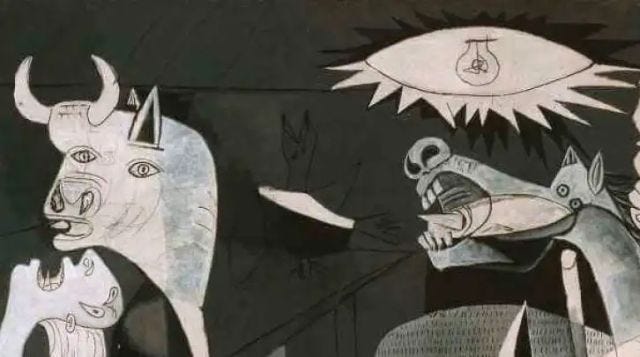
The horse occupies the center of the composition, wounded by a spear, its neck twisted and mouth opened wide in a neigh that becomes the dominant sound of the entire painting. A deafening scream. Picasso himself stated that it represented the Spanish people. But here too interpretations overlap: the horse’s body is dotted with black marks resembling the surface of a printed newspaper page — an explicit reference to the press through which Picasso first learned of the bombing. In the animal’s face, some scholars perceive a subliminal skull hidden between nose and teeth: death concealed within the scream of pain.
A more biographical reading, proposed by scholar José María Juarranz de la Fuente, sees the horse as a reference to Olga Khokhlova, Picasso’s first wife — an animal recurring throughout his work of the 1930s, a period marked by deep emotional crises. There is no need to choose between these interpretations: Guernica contains them all.
The fallen warrior lies beneath the horse’s hooves — the only man stretched out in the composition, the only one who does not scream because he no longer has a voice. The sword in his hand has been reduced to a fragment. Yet from this shattered body grows a small flower, tender, spectral, stubborn. It is one of the most powerful gestures in the entire work. The soldier is not a glorified hero; he lies defeated on the ground. And yet, amid devastation, something still insists on blooming.
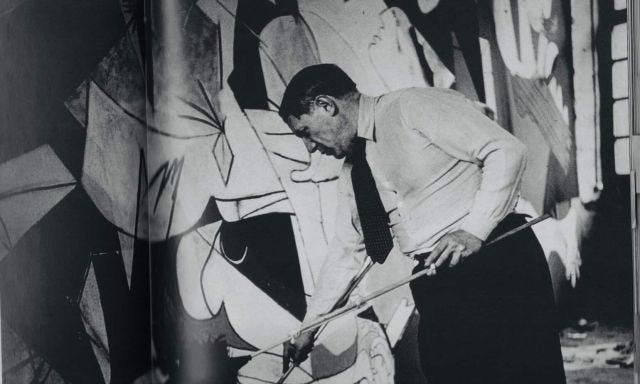
Pablo Picasso working on Guernica, photograph by Dora Maar.
The electric light bulb hangs at the top center of the canvas above the horse. It is an incongruous presence: why a light bulb in what should be an outdoor space? Its shape resembles an eye — an open eye watching from above, illuminating and judging. For some critics it is the eye of God observing humanity’s misery without intervening; for others it alludes to the bomb itself, to the sudden flash of phosphorus explosions tearing through the night.
There is also a simpler interpretation: it is the light of an ordinary home, the domestic detail revealing how the bombing struck precisely when people felt safe — in the evening, within the walls of their houses. Beside it, a woman leans through a window holding an oil lamp — older technology, almost a regression — illuminating the scene with melancholy rather than frightened eyes. She is the outside world attempting to understand, to bear witness, to shed light on what has happened. The lamp of a lost reason.
The dove is almost invisible, camouflaged within the gray background between the bull and the horse, at the level of their heads. One wing is missing. Its beak is open. It is not the dove of peace — it is shattered peace, peace screaming before it falls.
The composition, crossed by curved lines that move across the surface like shock waves, ultimately converges toward the bull’s head: all the movements of the figures seem drawn toward it, as though that motionless presence were the gravitational center around which the disaster revolves.
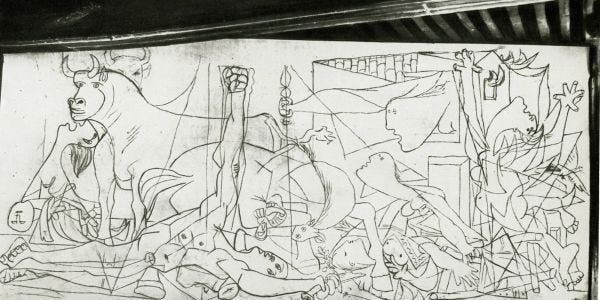
Preparatory drawing for Guernica, 1937, photograph by Dora Maar.
Guernica measures 349 centimeters high by 776 wide. Its dimensions are neither vanity nor a demonstration of technical power: they were necessary for the painting’s public destination — an exhibition pavilion meant to receive thousands of visitors — and to physically impose upon the viewer the vastness of what was being represented. A bombing cannot be told on an easel-sized canvas; it must become what we would today call an immersive experience.
But the most radical choice was the absence of color: none at all. Only white, black, and every shade of gray.
Picasso had not been present in Guernica. He had not seen the flames, breathed the smoke, or heard the screams. He had read the newspapers. And newspapers in 1937 printed photographs in black and white. That involuntary limitation became an aesthetic and ethical decision: by reproducing only what the press had conveyed, Picasso remained faithful to his condition as an indirect witness, transforming that honesty into expressive power. Gray intensifies the sense of death, ash, absence. Twisted forms cut across one another without the softening effect of color. White is not light but emptiness; black is not outline but annihilation.
When the 1937 Exhibition closed, the Spanish Republican government was already close to defeat. Picasso made a firm decision: Guernica would not set foot in Spain until Spain had democracy again. The work traveled to the United States, was exhibited at the Museum of Modern Art in New York under the label “on loan from the people of Spain,” and remained there for more than forty years. Picasso died in 1973, Franco in 1975. On October 10, 1981, the painting returned to Madrid, to the Reina Sofía Museum, where it still hangs today.
Guernica became the universal symbol of the evil of war not because it depicts one specific bombing, but because it transcends it and represents them all — past, present, and future. As art historian Giulio Carlo Argan wrote, Picasso succeeded in “uniting hatred and pity within the same curse,” transforming a precise historical event into something belonging to the human condition itself. Anyone who has endured war — any war, in any century — has recognized themselves in that canvas. For this reason Nazi propaganda included it in the 1937 Degenerate Art Exhibition in Munich. The Nazis feared the power of this painting.
Entering the twenty-first century, another eloquent political gesture connected to this work occurred in 2003. Colin Powell appeared at the United Nations to advocate for military intervention in Iraq, the same occasion on which he displayed the famous vial supposedly containing anthrax as proof of Iraqi weapons of mass destruction — a claim later revealed to be false. In the Security Council chamber hung a tapestry faithfully reproducing Guernica, donated to the United Nations by the Rockefeller family. That morning, Powell’s staff had it covered with a blue curtain.
The official explanation was that the black-and-white imagery “would create visual confusion during television broadcasts.” No one believed it. In reality, it is impossible to justify war, to announce bombings, with Guernica behind you. That act of censorship became, perhaps unintentionally, the clearest demonstration that the painting still works — not as a relic, not as the icon of a great artist, but because of its intrinsic force generated by an extraordinary expressive power.
There is an anecdote, told in slightly different versions but always attributed to the years of Nazi occupation in Paris, that summarizes Picasso’s intention. A Nazi officer visiting the artist’s studio stood before the great canvas in astonishment and asked: “Did you do this, Master?” Picasso replied: “No. You did.”
That anecdote crystallizes the purpose of the painting, entirely distant from mere description or didactic explanation, instead becoming an immediate and powerful concentration of expression capable of provoking an emotional explosion.
The bombing of Guernica — the targeting of defenseless civilians — may have been an experiment for Hermann Göring, but today it has tragically become a widespread method, military practice, a tool sold as decisive even though it never truly is. It is described as “surgical” while killing with very few distinctions: schools, hospitals, nurseries, shopping centers, homes are struck alike. The rubble looks the same today as it did then, as do the bodies crushed and buried alive beneath shattered buildings. The desperation of those digging through ruins is the same, as is the suffering of the wounded and of millions displaced, homeless, left with nothing.
A modern-day Guernica requires no updating. It continues to show us, with undiminished immediacy, the reflection of evil in our present.