
Black Dog: electronic

Making music is just battling with depression and mood really. If you’re down, you don’t really want to do anything.
Ken Downie
If you read the post on your phone and the button “Read in English” doesn’t work, scroll down the page: the English version is after the Italian one.
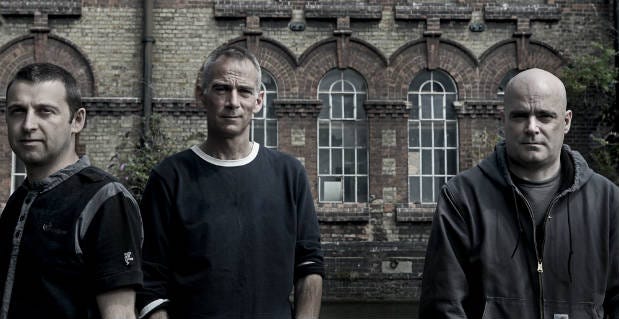
Ci sono collettivi che non nascono come band nel senso classico, ma sono strutture concettuali, sigilli sonori attivati dalla tecnologia. I Black Dog appartengono a questa categoria, non un gruppo lineare, ma un’entità mutevole, capace di ridefinirsi senza perdere il proprio centro gravitazionale. Quando emergono all’inizio degli anni Novanta, mentre l’elettronica britannica sta cercando di emanciparsi dalla pura funzione club, i Black Dog propongono una musica che è già linguaggio, architettura mentale, paesaggio simbolico. Il loro suono non accompagna: richiede attenzione, induce stati, costruisce spazi interiori.
Alla base del progetto ci sono Ken Downie, Ed Handley e Andy Turner. Una triade che funziona come un sistema chiuso, dove ogni elemento è interdipendente. Le loro composizioni sono fatte di sequenze irregolari, ritmiche spezzate, melodie oblique che affiorano come segnali cifrati. È un’elettronica che rifiuta la linearità della techno funzionale e si muove verso una dimensione più astratta, urbana, spesso inquieta. La città, la macchina, la memoria digitale diventano temi impliciti, mai dichiarati, ma costantemente evocati. Siamo in universo immerso nella fantascienza, tra le righe di un romanzo di Philip K. Dick.
Nel loro suono convivono techno decostruita, ambient tesa, dub digitale e un’eredità industriale filtrata attraverso una sensibilità profondamente britannica. Nulla è ornamentale. Ogni timbro è carico di intenzione, come se facesse parte di un vocabolario preciso. Album come Bytes e Spanners sono esperienze continue più che raccolte di tracce: flussi sonori che suggeriscono mappe, percorsi, derive. L’ascolto non è immediato, ma stratificato, e rivela la sua forza nel tempo.
Per comprendere fino in fondo i Black Dog è necessario registrare una frattura decisiva nella loro storia. Dal nucleo originariodei Black Dog nasceranno i Plaid, quando Ed Handley e Andy Turner intraprendono un percorso autonomo. I Plaid porteranno avanti una declinazione più melodica, luminosa e geometrica di quell’estetica Warp che i Black Dog avevano contribuito a fondare. Non si tratta di una semplice separazione, ma di una scissione quasi alchemica: stessa origine, esiti differenti. Dove i Plaid cercano equilibrio ed emozione, i Black Dog restano fedeli alla complessità, all’opacità, all’attrito concettuale.
Figura centrale, spesso defilata ma determinante, è quella di Ken Downie, leader e mente visionaria del progetto, scomparso recentemente. Downie incarnava un’idea quasi esoterica del fare musica: più interessato ai processi che al risultato, più alla coerenza che alla visibilità. La sua impronta è riconoscibile nella radicalità del progetto, nella scelta di rimanere ai margini delle mode, nella costruzione di un catalogo che sembra funzionare come un archivio occulto di stati mentali. La sua morte segna la perdita di una figura chiave dell’elettronica sperimentale britannica, ma anche la cristallizzazione definitiva del suo lascito, con l’ultimo bell’album “Loud Ambient”.
Il legame con la Warp Records è fondamentale. I Black Dog sono tra i primi a definire quello che negli anni Novanta verrà etichettato come IDM, pur andando ben oltre qualsiasi categoria. La loro musica anticipa l’idea dell’elettronica come ascolto domestico, come esperienza concentrata e riflessiva. Dischi pubblicati su Warp e su etichette affini mostrano una visione coerente, in anticipo sui tempi, che influenzerà profondamente le generazioni successive di producer.
Spesso si è parlato di una dimensione cinematica nel loro suono, ed è corretto intenderla in senso estetico più che funzionale. I Black Dog hanno esplorato l’idea di musica applicata a immagini astratte, pubblicità e cortometraggi, come suggerisce il progetto Music for Adverts (and Short Films). Più che accompagnare una narrazione visiva specifica, la loro musica costruisce immagini interiori, scenari mentali che sembrano già film senza schermo. Possiamo dire che la loro sia una musica visiva.
Un aspetto centrale del loro immaginario è il rapporto con l’esoterismo. Titoli, strutture ritmiche, ripetizioni ossessive e cicli sonori rimandano a ritualità, numerologia, sistemi simbolici. Non c’è folklore superficiale, ma una concezione del suono come strumento di alterazione della percezione. Le tracce funzionano come mantra digitali, loop ipnotici che sospendono il tempo lineare. La macchina diventa medium, il codice una forma di incantesimo contemporaneo.
Negli anni successivi il progetto continua a evolversi, rimanendo sempre riconoscibile. I Black Dog attraversano decenni senza mai semplificarsi, dialogando con nuove tecnologie e nuovi contesti senza perdere rigore. È una traiettoria coerente e solitaria, lontana dal consenso immediato, guidata da una visione artistica.
L’eredità dei Black Dog è profonda e spesso sotterranea. Senza di loro, molta dell’elettronica sperimentale contemporanea avrebbe un lessico più povero. Hanno dimostrato che la musica elettronica può essere pensiero, spazio, rituale. I Plaid ne rappresentano una prosecuzione luminosa, ma i Black Dog restano il nucleo oscuro, la matrice originaria, il sole nero. Un progetto che ha trasformato la tecnologia in linguaggio simbolico, il suono in architettura mentale, l’elettronica in esperienza iniziatica. Un’eredità che continua a vibrare sotto la superficie, silenziosa ma persistente. CLICCATE QUI per scoprire una playlist antologica della band di Sheffield, un universo visionario che merita attenzione.
Desiderate qualcosa di diverso dalle atmosfere ultraterrene dei Black Dog? Il jukebox di Mr Pian Piano con tutti i musicisti e le musiciste del nostro intrigante menù è come ogni domenica a vostra completa disposizione: classica, jazz, pop, rock e ambient sono lì ad aspettarvi. Se volete scoprire in dono altre monografie curate da Mr Pian Piano di decine e decine e decine (e decine) di superbi musicisti vi basta accomodarvi qui:
CLICCATE QUI e aprite l’archivio delle monografie di grandi musicisti in ordine alfabetico.
Volete esplorare il progetto multimediale online che sto realizzando con Adi Newton (Clock Dva, Anti Group) tra arte e musica? CLICCATE QUI per scoprirlo.
Stanchi di musica? Volete leggere di economia, politica e finanza con uno sguardo alieno? (((RadioPianPiano))) consiglia di frequentare Alieno Gentile e la sua dimora digitale.
PS: se volete sostenere (((RadioPianPiano))) sottoscrivete un abbonamento annuale (30 euro) o mensile di 5 euro. Il gesto sarà apprezzato visto il lavoro settimanale che c’è dietro a queste pagine. Non potete o non volete? Sottoscrivete la newsletter: è gratis. Grazie.
Black Dog: electronic
Making music is just battling with depression and mood really. If you’re down, you don’t really want to do anything.
Ken Downie
There are collectives that are not born as bands in the classical sense, but as conceptual structures, sonic sigils activated by technology. The Black Dog belong to this category: not a linear group, but a mutable entity, capable of redefining itself without losing its gravitational core. When they emerge in the early 1990s, as British electronic music is trying to emancipate itself from pure club functionality, the Black Dog propose a music that is already language, mental architecture, symbolic landscape. Their sound does not accompany: it demands attention, induces states, constructs inner spaces.
At the core of the project are Ken Downie, Ed Handley, and Andy Turner. A triad that functions as a closed system, where every element is interdependent. Their compositions are built from irregular sequences, fractured rhythms, oblique melodies that surface like encoded signals. It is an electronic music that rejects the linearity of functional techno and moves toward a more abstract, urban, often unsettling dimension. The city, the machine, digital memory become implicit themes—never stated outright, yet constantly evoked. We are in a universe steeped in science fiction, between the lines of a Philip K. Dick novel.
Their sound brings together deconstructed techno, tense ambient, digital dub, and an industrial legacy filtered through a deeply British sensibility. Nothing is ornamental. Every timbre is charged with intention, as if it belonged to a precise vocabulary. Albums such as Bytes and Spanners are continuous experiences rather than collections of tracks: sonic flows that suggest maps, routes, drifts. Listening is not immediate, but layered, revealing its power over time.
To fully understand the Black Dog, one must register a decisive fracture in their history. From the original core of the Black Dog, Plaid would emerge when Ed Handley and Andy Turner embarked on an autonomous path. Plaid would carry forward a more melodic, luminous, and geometric version of that Warp aesthetic the Black Dog had helped to establish. This is not a simple separation, but an almost alchemical split: the same origin, different outcomes. Where Plaid seek balance and emotion, the Black Dog remain faithful to complexity, opacity, and conceptual friction.
A central figure—often withdrawn yet decisive—is Ken Downie, leader and visionary mind of the project, who passed away recently. Downie embodied an almost esoteric idea of music-making: more interested in processes than results, in coherence rather than visibility. His imprint is evident in the project’s radicalism, in the decision to remain at the margins of fashion, in the construction of a catalogue that functions like an occult archive of mental states. His death marks the loss of a key figure in British experimental electronic music, but also the definitive crystallization of his legacy, sealed with the final, remarkable album Loud Ambient.
The relationship with Warp Records is fundamental. The Black Dog are among the first to define what in the 1990s would be labeled IDM, while always operating beyond any fixed category. Their music anticipates the idea of electronic music as domestic listening, as a concentrated and reflective experience. Records released on Warp and related labels reveal a coherent vision, ahead of its time, that would profoundly influence subsequent generations of producers.
Much has been said about a cinematic dimension in their sound, and it is correct to understand this in an aesthetic rather than functional sense. The Black Dog explored the idea of music applied to abstract images, advertising, and short films, as suggested by the project Music for Adverts (and Short Films). Rather than accompanying a specific visual narrative, their music constructs inner images—mental scenarios that already feel like films without screens. We can say that theirs is a visual music.
A central aspect of their imaginary is the relationship with esotericism. Titles, rhythmic structures, obsessive repetitions, and sonic cycles evoke rituality, numerology, symbolic systems. There is no superficial folklore here, but a conception of sound as a tool for altering perception. Tracks function like digital mantras, hypnotic loops that suspend linear time. The machine becomes a medium, code a form of contemporary spellcraft.
In the years that follow, the project continues to evolve while remaining unmistakable. The Black Dog move through decades without ever simplifying, engaging with new technologies and new contexts without losing rigor. It is a coherent and solitary trajectory, far from immediate consensus, guided by a clear artistic vision.
The legacy of the Black Dog is deep and often subterranean. Without them, much of contemporary experimental electronic music would possess a poorer vocabulary. They demonstrated that electronic music can be thought, space, ritual. Plaid represent its luminous continuation, but the Black Dog remain the dark core, the original matrix, the black sun. A project that transformed technology into symbolic language, sound into mental architecture, electronics into initiatory experience. A legacy that continues to vibrate beneath the surface—silent, yet persistent. CLICK HERE to discover an anthology playlist of the Sheffield band, a visionary universe that deserves attention.
Are you looking for something different from the otherworldly atmospheres of the Black Dog? Mr Pian Piano’s jukebox — with all the musicians featured in our intriguing menu — is, as every Sunday, at your disposal: classical, jazz, pop, rock and ambient await you. If you want to explore dozens (and dozens and dozens) of monographs curated by Mr Pian Piano on great musicians, just settle in here:
Want to explore the multimedia project online I’m creating with Adi Newton (Clock Dva, Anti Group) between art and music? CLICK HERE to discover it.
Tired of music? Do you want to read about economics, politics, and finance with an alien gaze? (((RadioPianPiano))) recommends visiting Alieno Gentile and his digital abode.
PS: If you want to support (((RadioPianPiano))), subscribe to an annual membership (30 euros) or a monthly one for 5 euros. The gesture will be appreciated given the weekly work behind these pages. Can’t or don’t want to? Subscribe to the newsletter: it’s free. Thank you.
The esoteric angle on Black Dog is brilliant, that 'digital mantra' concept really nails what makes their work feel ritualistic. The Plaid split being called 'alchemical' is spot-on too, same roots but completly different energies. I've always felt electronic music like this works best late at night when the logical brain shuts down and you can just existt in the loops. Shame about Downie's passing.